We are a group of scientists focused on Extreme Plasmas around Compact Objects (EPaCO), driven by one big question:
What does energetic radiation tell us about far-away astrophysical environments — and how can we build reliable digital twins of these extreme systems?
Our work focuses on the plasma physics of black holes, neutron stars, and magnetars — where multi-scale and multi-physics challenges drive some of the most dramatic and fascinating events in the universe. These turbulent, high-energy environments are at the intersection of astrophysics and computation, and demand a deeply interdisciplinary approach. We start by identifying open questions from observational astronomy and develop theoretical and numerical models to capture the nonlinear plasma dynamics and QED effects that shape these systems. To support this, we create and maintain simulation tools tailored for performance across scales and optimized for next-generation computing infrastructure. We also care about how our science is understood and shared, actively engaging in outreach to make complex ideas more accessible. Our aim is not only to answer today’s questions, but to build robust, transferable modeling frameworks that can advance discovery across the field. We are grateful for support from the National Science Foundation (NSF). See EPaCO group members.
Our Values
We build science that lasts — and we do it together.
Our group is grounded in the following principles:
- Curiosity first: we are excited about difficult problems and asking hard questions.
- Collaboration and openness: everyone contributes, and everyone learns.
- Lowering the entry barrier: we actively support newcomers developing their own curiosity.
- Modeling for impact: we contribute to open-source tools that outlive individual projects and serve the broader community.
- Care and credit: we value honest communication, clearly stated expectations, and giving credit to all stages of the scientific process.
Group Members & Collaborators
Strong-Field QED and Radiative Plasma Flows in Magnetar Magnetospheres
EPaCO team: Thomas Kornfeld (’28), Dr. Adrien Soudais, Owen Young (UG)
Modeling plasma flows and radiative feedback in magnetar magnetospheres using particle-in-cell simulations, with self-consistent strong-field QED effects and direct comparison to X-ray observations from NuSTAR, NICER, and XMM-Newton.
Bio / Details

Thomas Kornfeld (Undergraduate Researcher, Dartmouth College): I am a sophomore studying Mathematics and Physics, interested in the application of statistical methods to analyze stochastic astrophysical processes. My research involves efficiently determining the spectra of magnetar surface temperature distributions, for example by utilizing the machine learning model normalizing flows to continuously and bijectively map the input distribution of surface-emitted photons to observable spectra. Ultimately, I want to determine the likelihood of localized hotspots. In my free time, I train and coach others at the Dartmouth Gymnastics club. I also enjoy listening to Nu Metal, going skiing, and discussing Francophone history. I currently love the book How Not to be Wrong by Jordan Ellenberg!
If you’re interested in joining the group’s work on this topic, please email us a description of your research interests, program goals and a CV with contact information for references to start a conversation.
Coherent Radio Wave Generation in Relativistic Plasma Environments
EPaCO team: Dawei Dai (GR), Logan Eskildsen (’28), Nicole Wotring (’27)
Investigating observationally testable mechanisms for fast radio burst and transient radio wave generation like coherent emission during plasmoid mergers in reconnection and mode conversion in relativistic magnetized shocks.
Bio / Details
Logan Eskildsen (Undergraduate Researcher, Dartmouth College): I am a rising sophomore with a passion for the chaotic intricacies of high-energy astrophysical processes. My work in the EPaCO Group examines a possible FRB generation mechanism that meshes a magnetized shock and a standing Alfvénic perturbation in the magnetar wind region. I currently focus on the theory behind the simulation: deriving O-mode dispersion relations, MHD jump conditions, and frame transformations across the shock. During my work, I develop skills in data analysis and academic writing. In my free time, I love to teach snowboarding, cook for my family, and read good stories (currently One Hundred Years of Solitude by Gabriel García Márquez).
Dawei Dai (Graduate student, Dartmouth College): I am a first year graduate student at Dartmouth College, having just completed my Bachelor studies at Tsinghua University in China. My research interests focus on plasma dynamics in neutron star magnetospheres, hoping to explain their mysterious electromagnetic signals. My current research involves wave propagation in the magnetospheric plasma. I use a combination of theoretical analysis and numerical simulation to understand fundamental wave-plasma interactions, to explain the radio emission patterns from pulsars and magnetars.
If you’re interested in joining the group’s work on this topic, please email us a description of your research interests, program goals and a CV with contact information for references to start a conversation.
Radio Wave Propagation in Neutron Star Magnetospheres
EPaCO team: Joseph Kuester (’27), Dawei Dai (GR), Yuanhong Qu (external collaborator)
Studying how radio waves interact with plasma in extreme environments like neutron star magnetospheres, and how plasma conditions and magnetic geometries impact observable signatures such as polarization and frequency-dependent intensity.
Bio / Details
Dawei Dai (Graduate student, Dartmouth College): I am a first year graduate student at Dartmouth College, having just completed my Bachelor studies at Tsinghua University in China. My research interests focus on plasma dynamics in neutron star magnetospheres, hoping to explain their mysterious electromagnetic signals. My current research involves wave propagation in the magnetospheric plasma. I use a combination of theoretical analysis and numerical simulation to understand fundamental wave-plasma interactions, to explain the radio emission patterns from pulsars and magnetars.
Joseph Kuester (Undergraduate Researcher, Dartmouth College): I am a current junior at Dartmouth College majoring in physics and music. I am interested in plasma physics as it applies to fusion systems and technology, as well as with the magnetic field geometry around large neutron stars. I specialize mostly in theoretical work, but I have also worked in computational physics and am continuing to improve my skills in that area. Outside of physics, I spend my free time composing and writing about music, singing in various vocal ensembles, running, and reading mystery novels.
If you’re interested in joining the group’s work on this topic, please email us a description of your research interests, program goals and a CV with contact information for references to start a conversation.
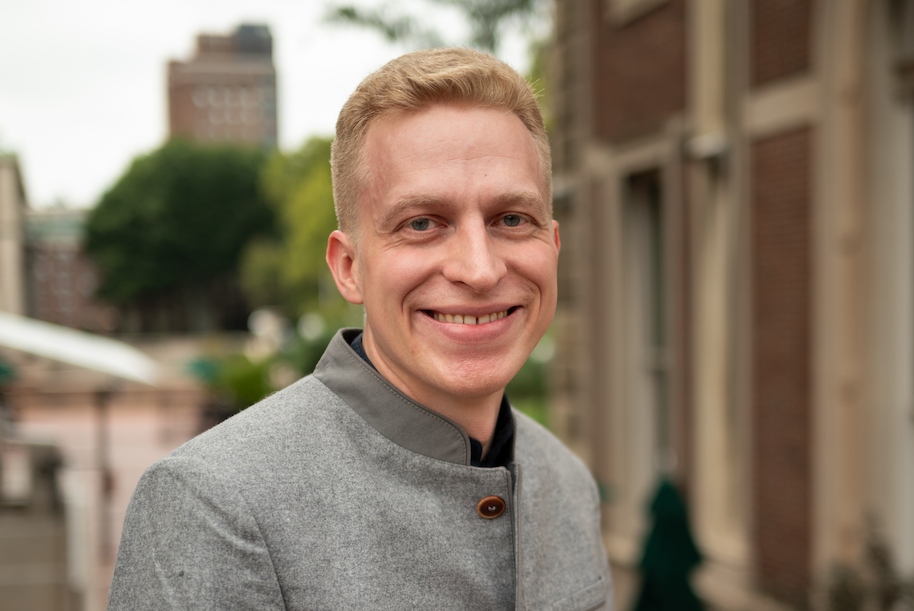
Jens Mahlmann (Assistant Professor, Dartmouth College): Group lead, coordination, and research facilitation. My work focuses on magnetar magnetospheres and method development. Currently, I’m particularly excited about Fast Radio Bursts (FRBs) and, long-term, I aim to develop reliable first-principles models of radiation-rich plasmas. Outside of work, I enjoy skiing, squash, biking, and Hip Hop music. I’m currently obsessed with the art of Natalia Lafourcade, and I love speaking Spanish whenever I can.
Alumni Spotlight
Elise Little (2025)
Role: URAD Research Assistant
Focus: Effective visualization of complex plasma phenomena
Marcos Cebrian (2025)
Role: URAD Research Assistant
Focus: Radio wave propagation, ponderomotive forces
Jazmín Romero Doldán (2025)
Role: Independent Senior Research
Focus: X-ray data analysis with NuSTAR, NICER, and XMM-Newton.
Outreach & Engagement
We’re exploring better ways to explain what astrophysical plasmas are and why they matter — to both scientists and the general public. This is a selection of our activities:
- Lecture: PHYS 118 – Computational Plasma Dynamics: An interactive course with theory and hands-on learning in computational plasma physics, using modern simulation tools (entity, Gkeyll, gPLUTO), high-performance computing, git version control, and generative AI. Supported by Vittoria Berta, and Adrien Soudais.
- Lecture: ASTR 75 – High-Energy Astrophysics: Includes a podcast series where students meet astrophysicists (Spring 2025 guests: Sophia Sanchez-Maes, Kenzie Nimmo). Interactive insights: A collection of web apps for intuition building in astrophysics. Teaching assistant: George Dufresne.
- Animations of our simulated compact object models and fundamental plasma processes, hosted on YouTube.
- Computational Plasma Physics at Dartmouth Knowledge Base: a growing internal wiki designed to help students get started with our tools, concepts, and research workflows. It lowers the barrier to entry and supports hands-on involvement from day one.
 jensmahlmann.com